 naymo
naymoKnow the second your site goes down.
Naymo checks your URLs every 5 minutes, emails you the instant status changes, and gives you a shareable public status page — so you hear it from us, not your users.
Included in Pro · 30-day money-back, cancel anytime
Replaces Pingdom / Better Stack ($10–25/mo) — included in naymo Pro ($19/mo)

What is uptime monitoring?
Uptime monitoring is a service that checks whether your website or app is online — over and over, around the clock — so you find out the moment it goes down instead of hearing it from an annoyed customer. Naymo checks each of your URLs every five minutes and emails you the instant the status changes, so an outage is something you catch and fix, not something that quietly costs you visitors and sales.
It also keeps a record. You get your uptime percentage and response-time history over time, so you can see whether your site is getting slower, spot patterns, and prove your reliability. And because incidents happen, every monitor can power a shareable public status page your users can check instead of flooding you with messages.
In plain language
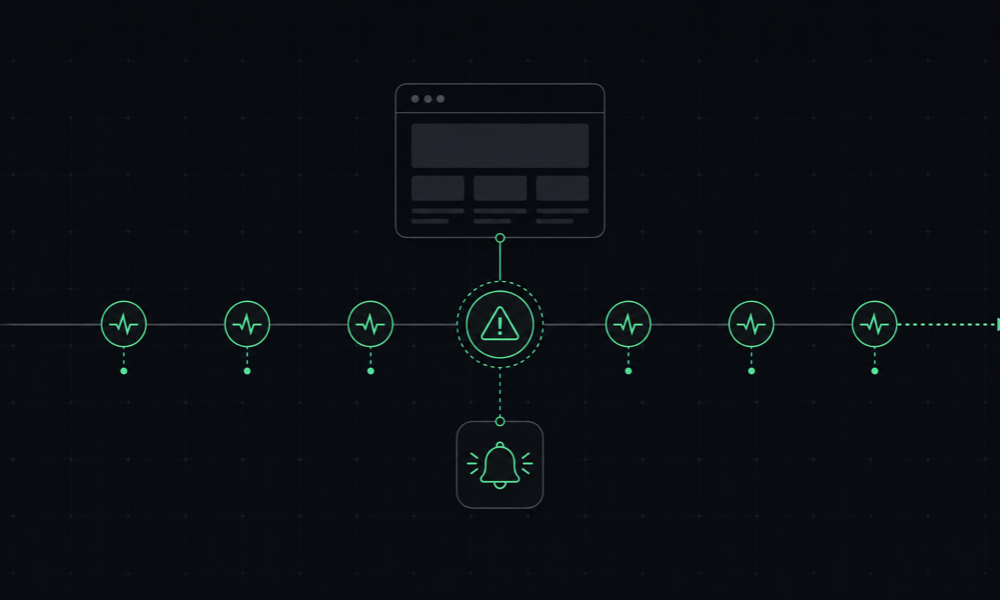
From outside your servers, Naymo requests your URL on a schedule, just like a visitor's browser would, and records whether it loaded, how long it took, and what status it returned. When a check fails — or recovers — that's a 'state change,' and that's when you get an email. You're alerted on what actually changed, not pinged constantly while everything is fine.
Who it's for
- Anyone running a website, store, or app that loses money when it's down
- Founders and developers who want to hear about outages before customers do
- Teams that need a public status page to share during incidents
- Operators who want an AI agent to add and manage monitors over MCP
What you get
5-minute HTTP(S) checks
Naymo checks your URLs every 5 minutes over HTTP(S), so you're not relying on a visitor to tell you something's broken.
Instant alerts on state change
The moment a site goes down — or comes back up — Naymo emails you. You're notified on the change, not buried in noise.
Uptime % + latency history
See your uptime percentage and response-time history over time, so you can spot trends and slowdowns before they become outages.
Shareable public status page
Give your users a public status page they can check during an incident — a shareable link that shows current and recent status.
Manage via MCP
Naymo exposes monitors over its MCP server, so an AI agent (or your own script) can add and manage checks for you.
Everything included, line by line
Each capability in one sentence — all of it on your own domain, on a single naymo plan.
- 5-minute checks
- Every URL is tested over HTTP(S) on a five-minute cadence.
- Down + recovery alerts
- Email the instant status changes — both ways, no noise.
- Uptime percentage
- Track reliability over time with a clear uptime figure.
- Latency history
- Spot slowdowns and trends before they turn into outages.
- Public status page
- A shareable page users can check during an incident.
- 10 monitors on Pro
- Watch your key URLs (50 on Business; 1 free).
- No agent to install
- Checks run from outside — just give Naymo the URL.
- Agent-ready over MCP
- An AI agent or script can add and manage monitors for you.
Live in three steps
-
Add a URL
Point Naymo at any URL you want watched. No agent to install — just the address.
-
We check it every 5 min
Naymo runs an HTTP(S) check every 5 minutes and records the result, latency, and status.
-
Get alerted + share your status page
You're emailed the instant status changes, and your public status page reflects it for your users.
naymo vs Pingdom
Pingdom is a well-known uptime and performance monitor. Here's an honest comparison for someone deciding between a dedicated monitoring product and getting it inside naymo.
- Monthly price Included in Pro ($19, $29 list) ≈ $10–25+ standalone
- Check frequency Every 5 minutes 1–5 min by plan
- Down + recovery alerts Email on state change Email/SMS/integrations
- Public status page Included Included / add-on
- Monitors included 10 Pro / 50 Business / 1 free Varies by plan
- Bundled with other tools Bio, SEO, analytics, email Monitoring suite
- Agent / API control MCP + REST API available
- Multi-region / deep RUM Focused HTTP(S) checks Deeper, enterprise-grade
Comparison reflects naymo Pro ($19/mo launch · $29 list) versus the competitor's comparable paid tier. Competitor capabilities and prices are approximate and may change.
$0 on domains · 0% selling fees on Pro — we sell software, not referrals. Our handoffs are neutral and unpaid, so the cheapest option is always the genuinely cheapest, and what you sell on your bio is yours to keep.
Pro / Business
Start free. Upgrade only when you need more — see exactly what every plan includes.
Questions, answered
How often is my site checked?
Every 5 minutes. Naymo runs an HTTP(S) check on each of your URLs on that cadence and records the status and response time.
When do I get alerted?
On state change. Naymo emails you the moment a site goes down and again when it recovers, so you're notified on what changed rather than getting constant pings.
Is there a status page I can share?
Yes. Every monitor can power a shareable public status page, so your users can check current and recent status during an incident.
Can an AI agent manage my monitors?
Yes. Naymo exposes uptime monitors over its MCP server, so an agent (or your own script over the REST API) can add and manage checks the same way you would.
Which plan is this on?
Uptime monitoring is available on Pro and Business. See the pricing page for the exact monitor limits on each plan.
How many sites or URLs can I monitor?
The free plan includes 1 monitor, Pro includes 10, and Business includes 50. Each monitor watches one URL, so you can cover your main site plus key endpoints as you grow.
Do I need to install anything on my server?
No. Checks run from outside, the same way a visitor's browser would load your page, so there's no agent or code to install — you just give Naymo the URL to watch.
Why does uptime monitoring matter for a small site?
If your site is down and you don't know, every visitor in that window leaves — and you may not find out until sales dip or someone complains. Monitoring turns an invisible outage into an instant alert you can act on, and a status page keeps users informed while you fix it.
Your whole stack, one subscription
naymo Pro bundles every tool below — on your own domain — for $19/mo, instead of paying each of these separately. Approximate published prices, for comparison.
- Linktree / Beacons Link-in-bio + selling $9–24
- Bitly / Short.io Branded short links $8–35
- Semrush / Ahrefs SEO audit + rank tracking $99–139
- Otterly / Profound AI-visibility (GEO) $29–99
- Pingdom / Better Stack Uptime monitoring $10–25
- Fathom / Plausible Privacy analytics $9–14
- ImprovMX / Forward Email Email forwarding $9
- Buttondown / Mailchimp Email broadcasts $9–20
Approximate published prices, for comparison — pick the tools you'd actually buy. naymo replaces them with one subscription, on your own domain.
Where to go next
- See the traffic you protect — downtime shows up as a traffic drop — watch both in one place.
- Protect your rankings — repeated downtime can hurt SEO; catch outages before Google does.
- Monitor your branded domain — watch the custom domain your bio and links run on.
Curious what you're overpaying today? Run the free domain renewal Overpay Audit to see your yearly savings, or compare every plan on the naymo pricing page.
Better together
Every tool runs on the same domain and the same Pro plan — add these next.
Know the second your site goes down.
Naymo checks your URLs every 5 minutes, emails you the instant status changes, and gives you a shareable public status page — so you hear it from us, not your users.